UV Light Source Module for Antiviral and Antibacterial Disinfection

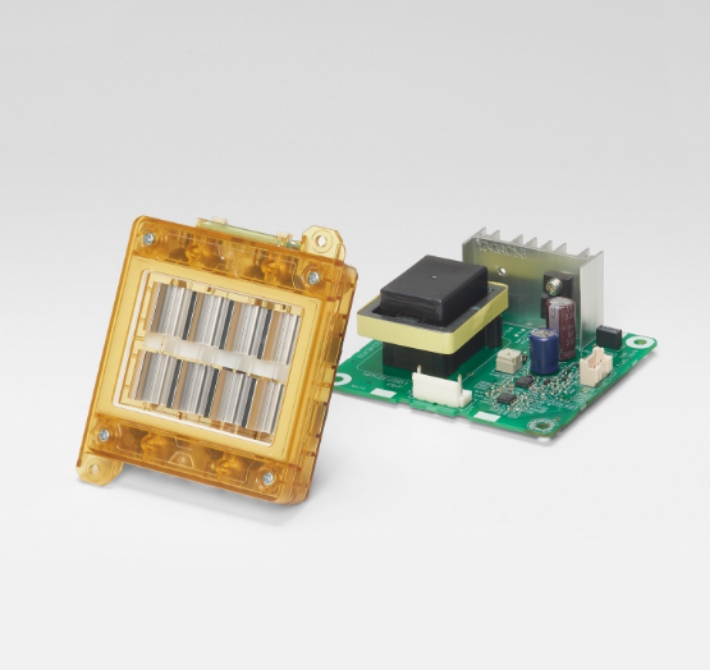
This 222 nm excimer lamp module uses USHIO’s proprietary optical filter to block harmful ultraviolet wavelengths.
Although it uses a UV-C light source, it can be used in occupied spaces and is effective against viruses, bacteria, and mold.
- * It provides effective disinfection of both surface and airborne viruses by irradiation with ultraviolet light.
- * This product uses “Care222®” technology developed by Ushio Inc.
- * Care222® is a trademark or registered trademark of Ushio, Inc. and Ushio America, Inc.
Features
Ultraviolet from which harmful wavelengths have been removed, allowing use in occupied spaces
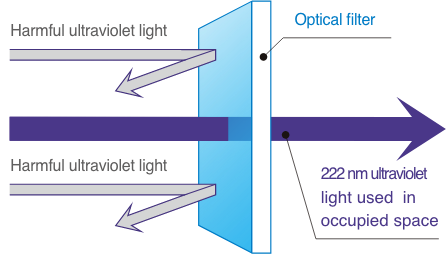
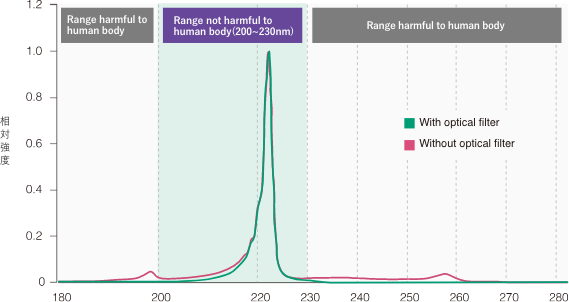
By combining a 222 nm peak-wavelength excimer lamp with a specialized optical filter, wavelengths harmful to humans (those above 230 nm) are blocked.
Image of harmful ultraviolet light cut off
spectral distribution
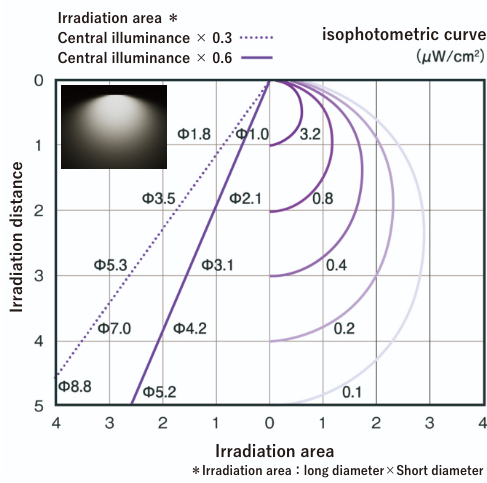
Choice of light distribution models
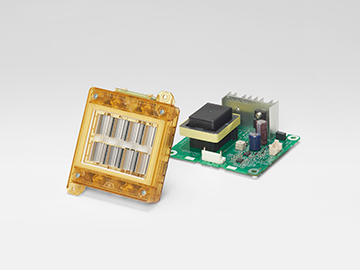
Standard type
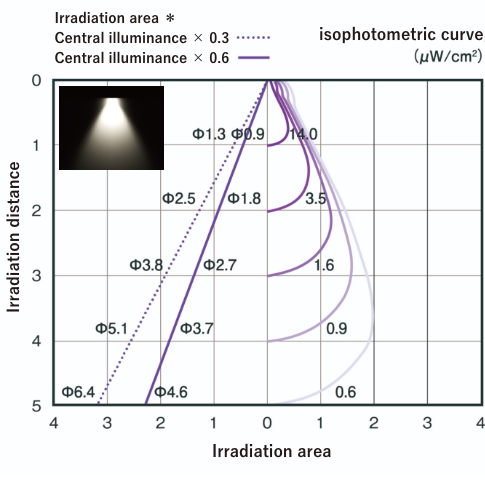
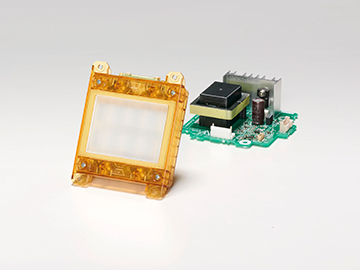
Wide-distribution type
Inverter for optimal light output
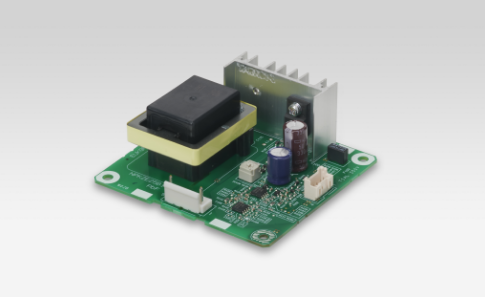
Inverter designed especially for use with Care222® Antiviral/Disinfection UV Light Source Modules. Not only does it improve luminous efficacy, but it is designed with safety in mind.* Tested for reliability in combination with the light source module.
* Design includes an ignition detection signal and guard function.
Mercury-free
Not only is the 222 nm excimer lamp mercury-free, but it allows extraction of the wavelength (222 nm) that is highly effective for disinfection.
By comparison, the wavelength extracted for disinfection from low-pressure mercury lamps is 254 nm, as this is the most efficacious spectral line available from mercury lamps.
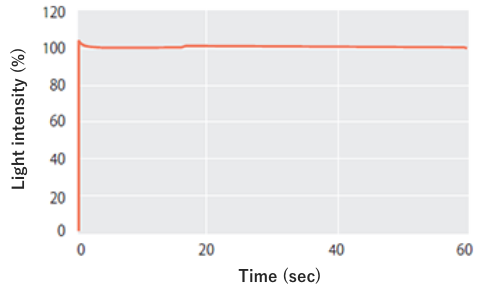
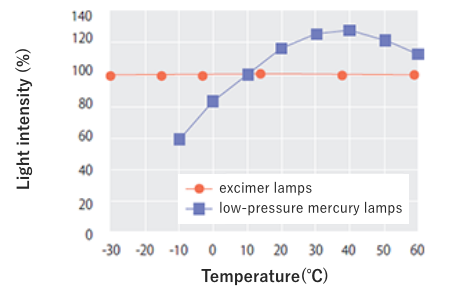
Since the lamp does not use mercury, not only does it reduce the burden on the environment, but it is less susceptible to environmental temperature than UV light sources that use mercury, and it provides much better ON/OFF characteristics.
Initial ignition characteristics of excimer lamps
Output performance comparison: excimer lamps vs. low-pressure mercury lamps
Product Specifications
Standard type
Wide-distribution type
- 横スクロールでご覧ください
| Type (Model) | Standard type (UXFL70-222B4-UIA) | Wide-distribution type (UXFL70-222B4-UIC) |
|---|---|---|
| Light source | excimer lamp (Main wavelength 222nm) | |
| UV intensity(μW/c㎡)※ | 14 | 3.2 ( 100% electric power ) |
| Dimensions(mm) | W75×D97×H28 | W75×D97×H26 |
| Product weight(g) | 120 | 125 |
| Power consumption(W) | 11 | 11 |
| Compatible inverter | PXZ120I2-A | PXZ120I3-A |
| Dimming function | ― | 100%,70%,40%,20% |
| Input voltage range | DC24V±1.2V | DC12V±1.2V |
| Inverter dimensions(mm) | W89×D83×H36 | W86×D85×H36 |
| Inverter weight(g) | 130 | 130 |
| Operation environment | Temperature(℃):0~50 Humidity(%RH):5~90(Non-condensing) |
Temperature(℃):0~50 Humidity(%RH):5~90(Non-condensing) |
| Storage environment | Temperature(℃):-10~60 Humidity(%RH):5~90(Non-condensing) |
Temperature(℃):-10~60 Humidity(%RH):5~90(Non-condensing) |
- * Value measured by USHIO at 100 cm from the irradiation window.
- * UV intensity may vary according to environment conditions.
- * Due to emission characteristics of the light source, variations in UV intensity may be perceived as flickering.
- ・Specifications and design are subject to change without notice for product improvement purposes.
- ・Limit the amount of UV irradiation to the threshold limit value (TLV) established by the standards set by the American Conference of Governmental Industrial Hygienists (ACGIH). The ACGIH (American Conference of Governmental Industrial Hygienists) recommends threshold limit values (TLVs) for acute UV radiation injury. Based on these TLVs, international standards (IEC, UL, JIS) specify permissible values for 222 nm UV in each region.
- ・When designing equipment, please follow the risk group classification and labeling in accordance with IEC 62471.
IEC 62471 specifies the evaluation of photobiological safety of lamps and lamp systems, and has been expanded into JIS C 7550.
IEC/TR 62471-2 specifies the label display for the risk group classification required by IEC 62471.